
Running a Sex Offender Check in Geneva County
The main public route is the ALEA Sex Offender Registry. ALEA Criminal Justice Information Services maintains the state system, but local law enforcement creates the updates. For Geneva County, the sheriff registers people who live, work, or attend school in the county and forwards current photographs and fingerprints to ALEA. An offender also must report qualifying changes. That division of work matters: the state page displays the record, while the local agency checks facts on the ground.
Start with the ALEA-linked search for a Geneva County record. Compare the name, aliases, photograph, physical description, residence, and offense details before drawing a conclusion. If a listed Geneva County address appears wrong, report it to local law enforcement instead of confronting anyone at the location. The ALEA Sex Offender Registry Unit can answer state-system questions at 334-676-7898 or sexoffenderunit@alea.gov. The verified county telephone route is 334-684-5600; ask for the Geneva County Sheriff's Office and confirm the registration contact or location before traveling.
Geneva County Registry Update Chain
ALEA says local officers collect registration data, a current photograph, and fingerprints, then send those items to the state. The public record is therefore only as current as the information reported and verified through that chain. Adults verify in their birth month and every three months after that. The legislative sheriffs handbook also describes a $10 charge for each quarterly appearance and for establishing or ending registration. A person who has more than one registration connection may need to report in every county of residence, work, or school.
The ALEA registry FAQ explains the update process and listing limits. The official source view below helps show why Geneva County registration starts locally even though the public search is statewide.
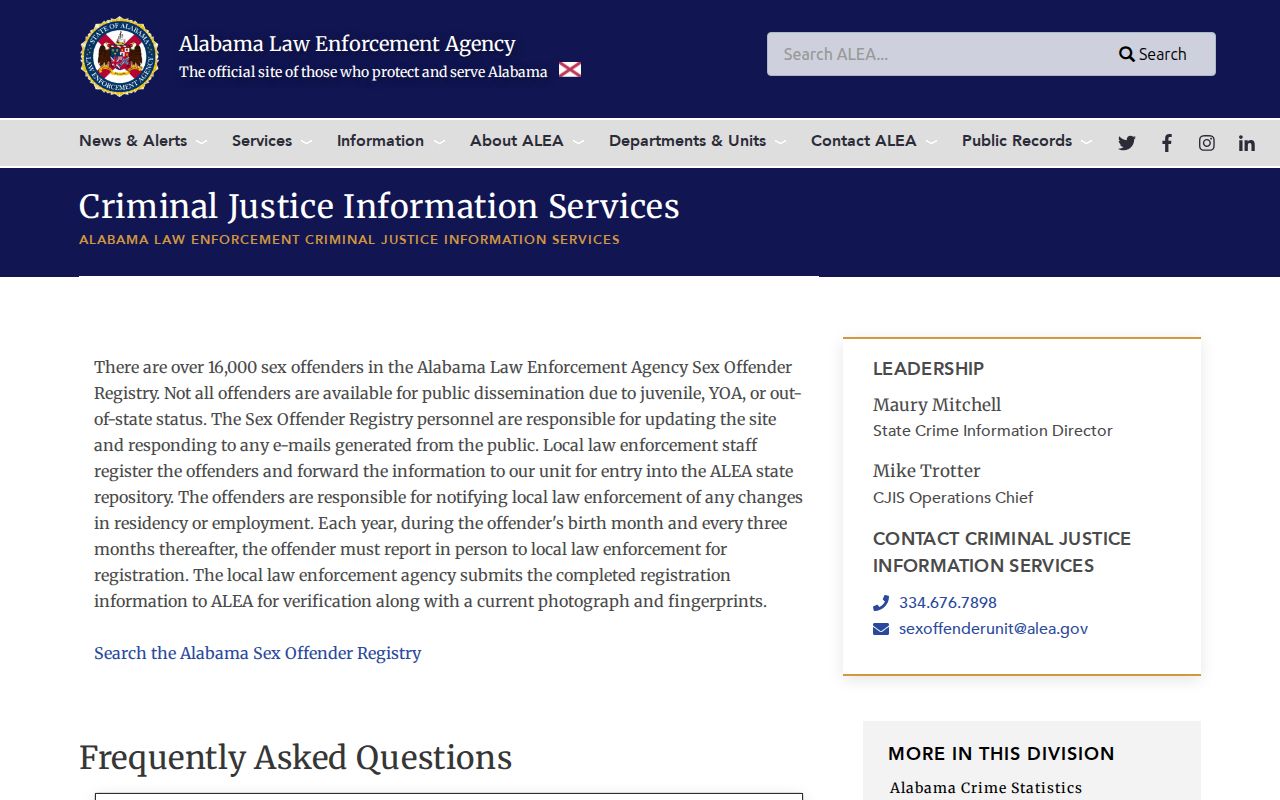
That local-to-state path also explains why a suspected error should go first to the Geneva County sheriff or the law-enforcement agency responsible for the address.
Searching the ALEA Sex Offender Registry
The official ALEA-linked registry search is free, although its vendor-hosted interface blocked full inspection during research. Alabama law still verifies which search keys the public system must support. Use only facts you know, then open a result and compare several identifiers. A name match alone is not enough, especially when aliases or similar names appear.
- Open the ALEA registry page and follow its link to the public search. Read and accept any use notice shown by the live interface.
- Search with a verified statutory field such as name, city or town, county, ZIP code, or geographic radius. Select Geneva County when that filter is useful.
- Review the result list and compare the photograph, aliases, physical description, and locations. Do not rely on one shared name.
- Open the full profile. Read the offense, statutory text, registration status, addresses, and vehicle information in context.
The following field inventory reflects what Alabama law authorizes, while marking every interface detail that the blocked vendor page left unverified.
| Field Label | Type | Required | Notes |
|---|---|---|---|
| Name | Text search | Not verified | Authorized by Ala. Code §15-20A-8(e) |
| City or town | Location search | Not verified | Use the place tied to the address being checked |
| County | Location search | Not verified | Geneva County narrows the state results |
| ZIP code | Location search | Not verified | Authorized by statute; live format was not inspected |
| Geographic radius | Area search | Not verified | Exact radius choices were not verified and are not assumed |
Geneva County Registry Search Limits
A missing profile does not prove that no sex-offense case exists. ALEA notes that a first conviction for Indecent Exposure or Sexual Misconduct is not posted. Many juvenile and Youthful Offender matters do not appear in the same way. Some out-of-state, federal, military, or Indian-country cases may also wait for a due-process decision before publication. Timing adds another gap because listing generally starts after conviction and release through probation or the end of a sentence.
For that reason, a Geneva County registry result is not a complete criminal history. It answers whether the state is publicly listing a person under Alabama's registration law at the time of the search. It does not list nonconviction arrests. A court case can still exist without a public profile, and the Geneva County criminal court case file is the better source for filed charges, docket events, and disposition.
Note: Search absence is not clearance, and a listed profile is not an individualized finding that a person will reoffend.
What a Registry Profile Shows
Alabama law defines the public profile as a notification record. The field set helps a reader distinguish people and understand why an entry appears. It includes far more than a name, but it leaves out sensitive details that serve no public-notice role. Read each field as reported registry data, then contact the proper agency if a key fact appears stale.
| Name & Aliases | Legal name, aliases, nicknames, and ethnic or Tribal names used to identify the registrant |
|---|---|
| Photo & Physical Description | A current photograph and identifying physical traits supplied through registration |
| Registered Locations | Every residence plus school and employer addresses, including transient or day-labor information when applicable |
| Offense & Statute | Sex-offense conviction or adjudication history and the text of the governing statute |
| Vehicles | License plates and descriptions of personal or work vehicles, aircraft, and watercraft |
| Registration Status | Public status information, including whether the person is listed as absconded |
| Protected Fields | Victim identity, Social Security number, travel documents, online identifiers, and internet-service-provider data are not public |
Geneva County Registry Address Rules
Alabama's adult residence rule is not a search radius. Under Ala. Code §15-20A-11, the 2,000-foot restriction is measured in a straight line from property line to property line. It applies to schools, childcare facilities, resident camps, and specified locations connected to a victim's family, with statutory exceptions and possible preapproval in defined circumstances. The live registry's geographic-search choices are separate and were not verified.
The same distinction applies to notice distance. Section 15-20A-21 changes community-notification reach based on population. The research confirms a 1,500-foot residential notice area and three-mile notice to schools and childcare for cities of at least 5,000 that are not Alabama's four largest. Those figures should not be projected onto every Geneva County town. Local law enforcement applies the statute to the relevant place and facts.
Registration Requirements and Levels in Alabama
Alabama does not publish adults in the familiar federal Tier I, II, and III duration scheme. Adults with a qualifying offense generally register for life under §15-20A-3. Juvenile treatment differs by adjudication and risk assessment. The table uses Alabama's actual categories so a Geneva County sex offender check does not turn a statutory record into an invented tier score.
| Alabama Category | Duration or Public Treatment | Key Caution |
|---|---|---|
| Adult qualifying offender | Generally lifetime registration | Not displayed as a federal three-tier duration table |
| Juvenile age 14 or older with an enumerated severe adjudication | Lifetime; a petition route may arise after 25 years | High-risk assessment affects public notification |
| Other qualifying juvenile | Generally 10 years from first registration | Juvenile and Youthful Offender matters can be nonpublic |
| First Indecent Exposure or Sexual Misconduct conviction | ALEA says it is not posted | The court case may still exist |
| Out-of-state, federal, military, or Indian-country matter | May await a due-process determination | Absence does not prove no qualifying case exists |
Adults report during their birth month and every three months after that. Frequency describes a registration duty, not how often a user must search.
Geneva County Registry Reporting Cycle
Quarterly verification gives Geneva County officers repeated points to confirm information and collect changes. Yet the public system still depends on what was reported and what local law enforcement has had time to verify and forward. A move, new job, school connection, or vehicle change can create a gap between real life and the public display. That is why the ALEA page directs concerns about a wrong address to local law enforcement.
If a Geneva County entry looks wrong, save the public details needed to describe the issue. Do not visit the address. Call the responsible local agency, explain the possible mismatch, and allow officers to check it. The sheriff is the county registration channel. A city police department may handle an address within its jurisdiction, while ALEA's SOR Unit handles questions about the statewide record. This route protects both the reporting person and people at the listed location.
Geneva County Registry Versus NSOPW
The ALEA search is the first stop for a current Alabama entry because Geneva County registration data flows through Alabama's system. The National Sex Offender Public Website, operated by the U.S. Department of Justice, adds a cross-state search layer. It is useful when a person has lived beyond Alabama or when the location tied to the search sits near a state line. NSOPW gathers public data from participating jurisdictions; it does not replace local verification.
The official NSOPW search view shows the national search layer used after the state check.
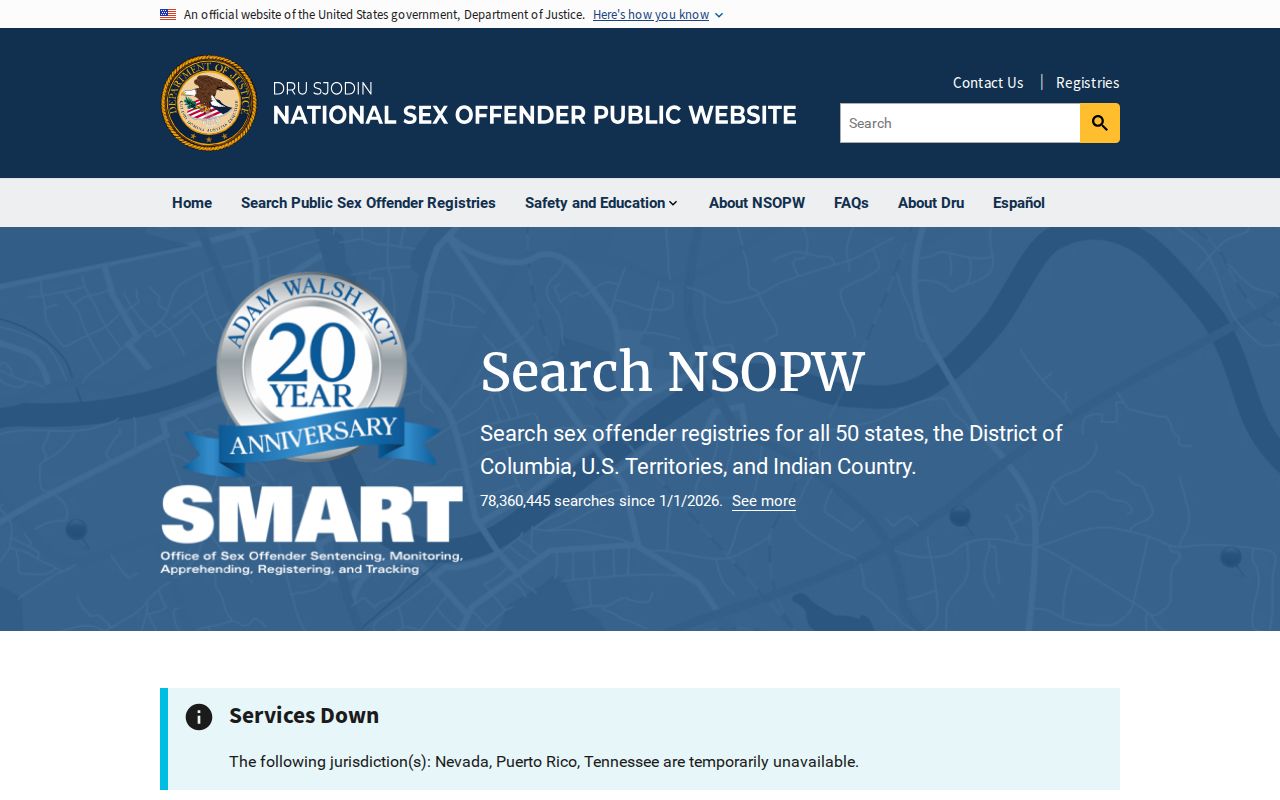
A cross-state result should be read through the source jurisdiction's profile, while a Geneva County address concern still belongs with local law enforcement.
Lawful Use and Community Notification
Registry information supports personal, family, and community safety. It can help residents understand a public notice, check an address, or plan a talk about safe boundaries. Inclusion follows Alabama law. It is not an ALEA finding that assigns each person a level of dangerousness, and it is not permission to contact a registrant, a family member, an employer, or anyone at a listed place.
Community notice is also a law-enforcement function. Its scope depends on the statute and the population of the place involved. Readers should use official notices and the state profile, then send suspected noncompliance to the Geneva County sheriff or the proper city police department. Public action should stop there.
Registry misuse is a crime: Ala. Code §15-20A-8(h) warns that using registry information to injure, harass, or commit a crime against a registrant or anyone at a listed residence or workplace may bring civil and criminal consequences.